

 Online Learning
Short-Term Goals for Students to Master Time Management
| Short-term goals for students are small, achievable objectives that can be completed within a short time frame, such as days or weeks. These goals help students stay focused, build consistent study habits, and gain confidence through quick progress. Common examples include completing assignments on time, improving test scores, developing better time management, or mastering a specific subject topic. |
Setting short term goals for students is one of the most effective ways to improve time management, stay organized, and develop strong study habits. Unlike long term goals, which may take months or years to achieve, short-term goals provide students with clear, actionable steps that ensure steady progress toward academic success.
Whether you are a parent, teacher, or student, understanding how to set short-term goals makes it easier to create achievable targets, stay on track, and celebrate progress along the way.
In this guide, you’ll discover practical student goal-setting tips, explore examples of short-term goals and learn effective strategies for tracking progress and staying motivated every step of the way.
What is a Short-Term Goal?
A short-term goal is a clear, specific objective that can be achieved in the near future, usually within days, weeks, or a few months. Unlike long-term goals, which require years of planning, short-term goals are bite-sized steps that help students stay focused, motivated, and organized.
For students, short-term goals might include completing homework on time, reading a chapter daily, improving a grade in a subject, or participating actively in class. For parents and teachers, understanding these goals helps guide and support students in setting realistic, achievable targets and tracking their progress effectively.
Benefits of Short-Term Goals
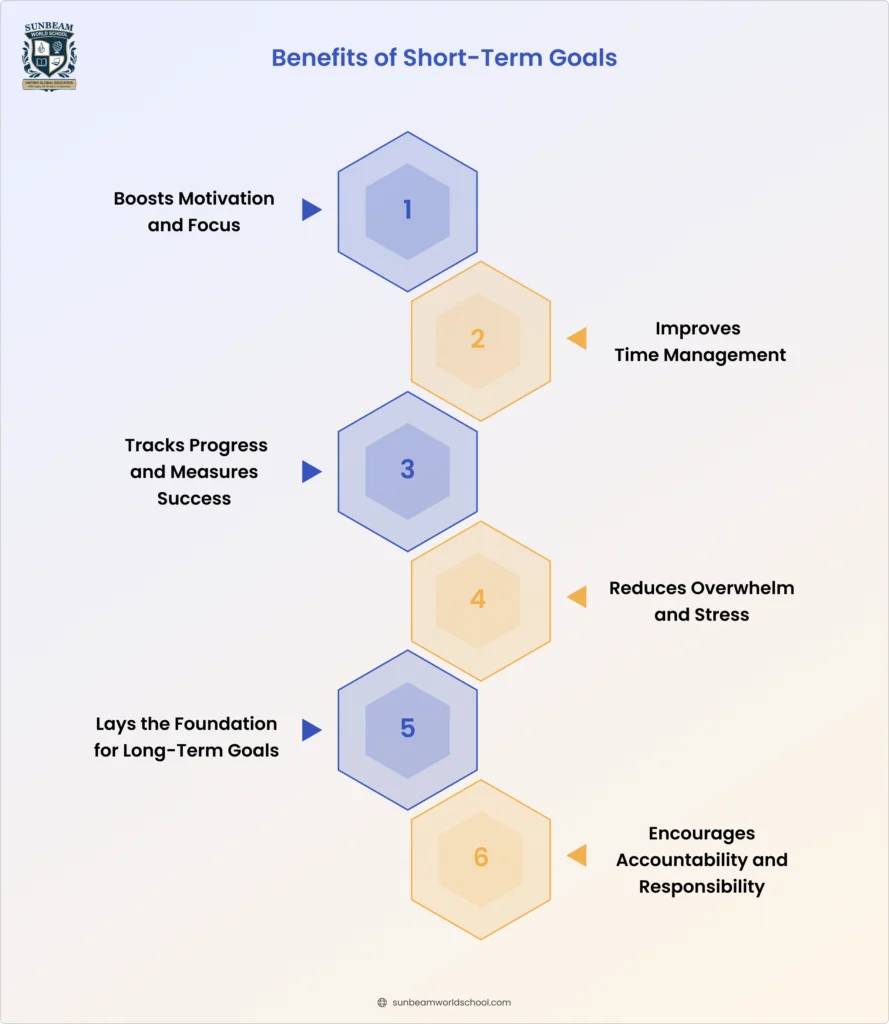
Short-term goals play a crucial role in academic success, personal growth, and effective learning. For parents and teachers, understanding these goals helps provide the right support, encouragement, and structure.
1. Boost Motivation and Focus
Short-term goals give students a clear sense of purpose. Completing small, achievable tasks regularly boosts confidence, reinforces positive habits, and keeps students motivated to tackle bigger challenges.
2. Improve Time Management
Breaking large assignments or projects into manageable short-term goals teaches students how to prioritize tasks and use their time effectively. Parents and teachers can guide them in planning study schedules and meeting deadlines.
3. Track Progress and Measure Success
Short-term goals provide measurable milestones. Students can see tangible results of their efforts, which helps in self-assessment and encourages continual improvement. Teachers can also use these goals to monitor performance and provide timely feedback.
4. Reduce Overwhelm and Stress
Large tasks or academic pressures can feel daunting. Short-term goals divide these tasks into smaller, achievable steps, making the workload feel manageable and reducing stress for students.
5. Lay the Foundation for Long Term Goals
Consistently achieving short-term goals helps students build discipline, resilience, and momentum. These small wins act as building blocks for long-term success, such as graduating with good grades, developing new skills, or pursuing future career aspirations.
6. Encourage Accountability and Responsibility
By setting and following short-term goals, students learn to take responsibility for their learning and actions. Parents and teachers can reinforce this habit by guiding goal-setting and celebrating achievements.
What Makes a Good Goal?
A good goal is more than just a wish—it is specific, actionable, and achievable, guiding students toward success while giving parents and teachers a clear framework to support them.
Whether it’s academic, personal, or extracurricular, effective goals follow certain principles to ensure progress and motivation.
1. Specific
A goal should clearly define what needs to be achieved. Instead of “I want to get better at math,” a specific goal would be, “I want to complete all algebra homework with at least 80% accuracy this week.” Specific goals remove ambiguity and give students a clear direction.
2. Measurable
Progress must be quantifiable. Measurable goals allow students, teachers, and parents to track success and adjust strategies if needed. Example: “Read 20 pages of a book every day for one week.”
3. Achievable
Goals should be realistic and attainable within the student’s current capabilities and timeframe. Unrealistic goals can lead to frustration and decreased motivation, while achievable goals encourage confidence and persistence.
4. Relevant
Good goals are aligned with broader objectives. Academic goals should support long-term success, personal growth, or skill development. For instance, improving essay-writing skills contributes to better grades in English and builds lifelong communication abilities.
5. Time-Bound
Every goal should have a clear deadline. Time-bound goals create a sense of urgency and focus, encouraging students to manage their time effectively. Example: “Submit science project by Friday” rather than “Submit it sometime.”
6. Flexible and Adaptable
While structured, good goals allow adjustments if circumstances change. Parents and teachers can guide students to modify timelines or methods without losing sight of the outcome.
7. Motivating and Inspiring
A goal should excite and inspire the student, making them want to take action. Intrinsic motivation increases engagement and persistence, helping students push through challenges.
How to Set Effective Short-Term Goals
Setting short-term goals for students is more than just writing down tasks — it’s a strategic process that ensures your goals are actionable, achievable, and aligned with your bigger ambitions.
When done right, student goal setting tips can help you stay motivated, track progress, and build habits that last. Here is how to get started with daily goals for students:
1. Understand Your Long Term Vision
Before setting short-term goals, clarify your long-term goals. Knowing your long-term vision ensures that your short-term goals as a student are relevant and meaningful.
Ask yourself:
-What do I want to achieve academically, personally, or professionally?
-Where do I see myself in 6 months, 1 year, or after graduation?
-What skills or habits do I need to develop to reach these goals?
| For example: -Long-term goal: Top the Class -Short-term goals: Complete weekly study sessions, improve assignment scores, participate in peer study groups |
2. Use the SMART Framework
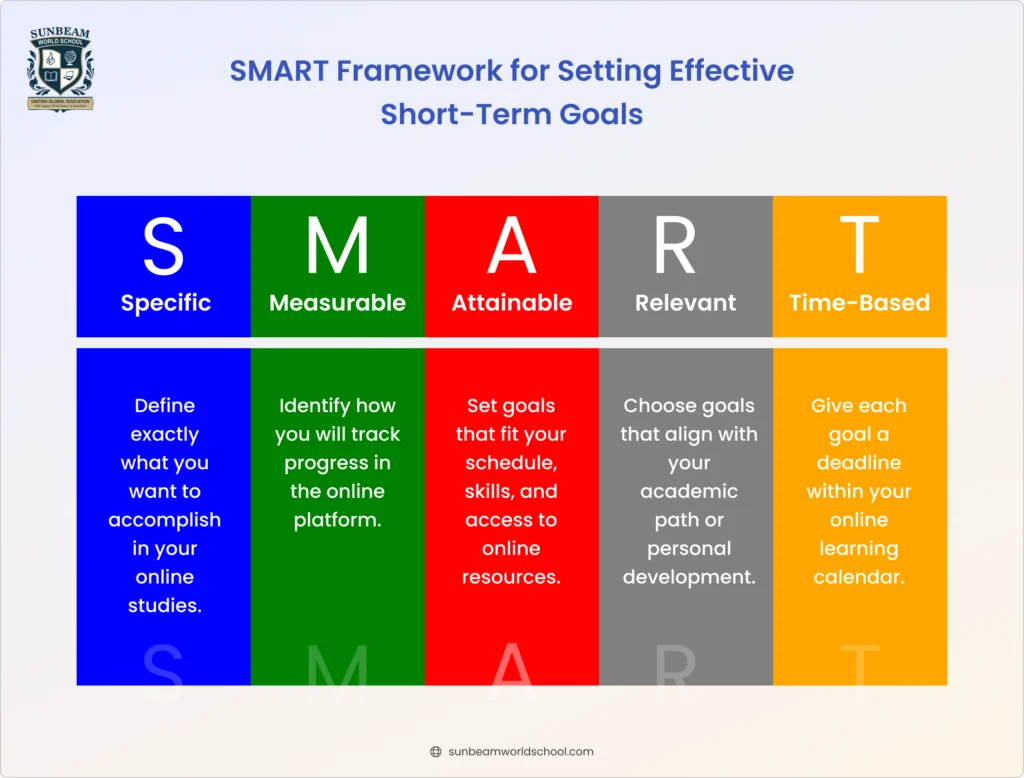
A proven method for creating effective short-term goals for students is the SMART framework:
-Specific: Clearly define what you want to achieve. Avoid vague goals like “study more.” Instead, say, “Study 1 chapter of Physics every Monday, Wednesday, and Friday.”
-Measurable: Include criteria to track your progress. For example, “Complete 5 practice problems daily” or “Write 500 words for my essay each day.”
-Achievable (Realistic): Goals should challenge you but remain attainable. Don’t plan to learn an entire subject in a single day; break it into smaller milestones.
-Relevant: Make sure your goal aligns with your academic, personal, or career ambitions. For example, improving your math skills is relevant if you aim to pursue engineering.
-Time-Bound: Set a clear deadline or time frame, such as “Complete 4 chapters by the end of the month.”
Example of a SMART short-term goal:
I will complete 10 practice questions in Algebra every day for the next 2 weeks to improve my test score by at least 5%.”
3. Break Goals Into Actionable Steps
Even well-defined short-term goals for students can feel overwhelming if they are too broad. Breaking goals into smaller, actionable tasks helps you stay focused. This approach transforms your goal into manageable steps and makes tracking progress easier.
-Step 1: Define the main goal
-Step 2: Identify tasks
-Step 3: Assign a timeline to each task
| For Example: If the goal is to improve essay writing skills, then break your task and set a short goal like writing 300 words daily, revise grammar rules, read academic essays. |
4. Prioritize Your Goals
Students often set multiple short-term goals, leading to overload and burnout. To avoid this:
-Identify which goals are most urgent or have the highest impact.
-Focus on 2–4 short-term goals per week or month.
-Break bigger goals into smaller cycles — weekly or biweekly objectives.
| For Example: If your goals are “improve grades in math, join a club, and learn to cook,” prioritize based on deadlines or importance. Perhaps study sessions take precedence this week, while club activities start next week. |
5. Create a Structured Plan
Planning is crucial for effective student goal setting. Structured planning ensures your short-term goals for students become part of your daily routine. Consider these strategies:
-Use a planner, calendar, or digital tool to schedule tasks.
-Treat each task as a commitment, just like classes or exams.
-Set reminders for deadlines or weekly check-ins.
| For Example: Create schedule for a week: Monday: Review Math notes 45 minutes, read a chapter of History Tuesday: Practice Chemistry problems, review previous essays |
6. Track and Measure Progress
Tracking your progress is essential for motivation and accountability. Regular tracking helps maintain momentum and allows you to adjust goals when necessary. Use methods like:
-Daily or weekly journals: Record completed tasks and accomplishments
-Progress charts: Visual trackers for tasks completed or skills learned
-Digital apps: Trello, Notion, or Google Calendar for reminders and updates
| For Example: Ask Questions like-Did I complete my tasks?-What obstacles did I face?-How can I improve next week? |
7. Stay Flexible and Adjust Goals
Life as a student is unpredictable — deadlines shift, exams are rescheduled, and personal responsibilities arise. Remember, flexibility doesn’t mean giving up, it ensures your short-term goals as a student stay realistic and achievable. Flexibility is key:
-Adjust timelines if necessary
-Reassess goals that feel too ambitious
-Replace or reprioritize goals as your circumstances change
| For Example: You planned to study two chapters tonight, but an unexpected school event took up your evening. Instead of stressing, you adjust your goal to one chapter and move the second to tomorrow. You stay on track without feeling overwhelmed. |
8. Maintain Balance in Your Goals
Many students focus only on academics and ignore other areas, which can lead to burnout. Balanced short-term goals for students foster holistic growth, leading to sustained productivity and wellbeing. Include short-term goals across multiple aspects of your life:
-Academic: Improve grades, complete assignments, participate in study groups
-Health & Fitness: Exercise 2–3 times per week, maintain a healthy diet, sleep on schedule
-Personal Growth: Read a book, learn a new skill, journal daily
-Social Life: Spend quality time with friends/family, join clubs or community activities
-Financial Goals: Save money, budget weekly, track spending
| For Example: Instead of setting only academic goals like “finish assignments on time” or “study 1 hour daily,” a student also sets small goals in other areas — such as exercising for 15 minutes, reading a fun book twice a week, and spending 20 minutes talking with family or friends. |
9. Learn From Setbacks
Even with careful planning, not all goals will be met. Treat setbacks as learning opportunities:
-Identify what prevented success: time management, lack of motivation, unrealistic target
-Adjust your approach without feeling discouraged
-Use the experience to improve future goal-setting
| For example: You set a goal to study Math for 1 hour every day, but after one week, you managed only 3 days. Instead of feeling disappointed, you review what went wrong. You realize your schedule was too tight because of sports practice and homework. |
10. Celebrate Small Wins
Celebrating progress keeps motivation high, start by rewarding yourself for completing daily or weekly tasks. Even small wins reinforce study habits for students and make the journey toward long-term goals enjoyable.
| For Example: If you completed your weekly study schedule then, enjoy a special snack, watch an episode of your favorite show, or take a relaxing break outside.You can treat yourself with your favourite coffee |
Short-Term Goal Examples for Different Age Groups
These Short-term goals differ by age, so it’s important to choose targets that match students’ learning abilities and responsibilities. Below are practical examples for primary and high school students to guide daily study habits and academic growth.
| Age Group | Short-Term Goal Examples |
| Primary School Students | • Complete homework daily for one week • Learn weekly spelling words or multiplication tables • Read one short story or chapter each week • Improve handwriting or neatness within a month • Organize school bag and books independently • Participate actively in class activities |
| High School Students | • Improve scores in the next test or assessment • Follow a daily study schedule for two weeks • Complete assignments before deadlines • Strengthen performance in a weak subject • Improve time management between studies and activities • Prepare effectively for upcoming exams or presentations |
50+ Short Term Goals Examples for Students to Achieve Success
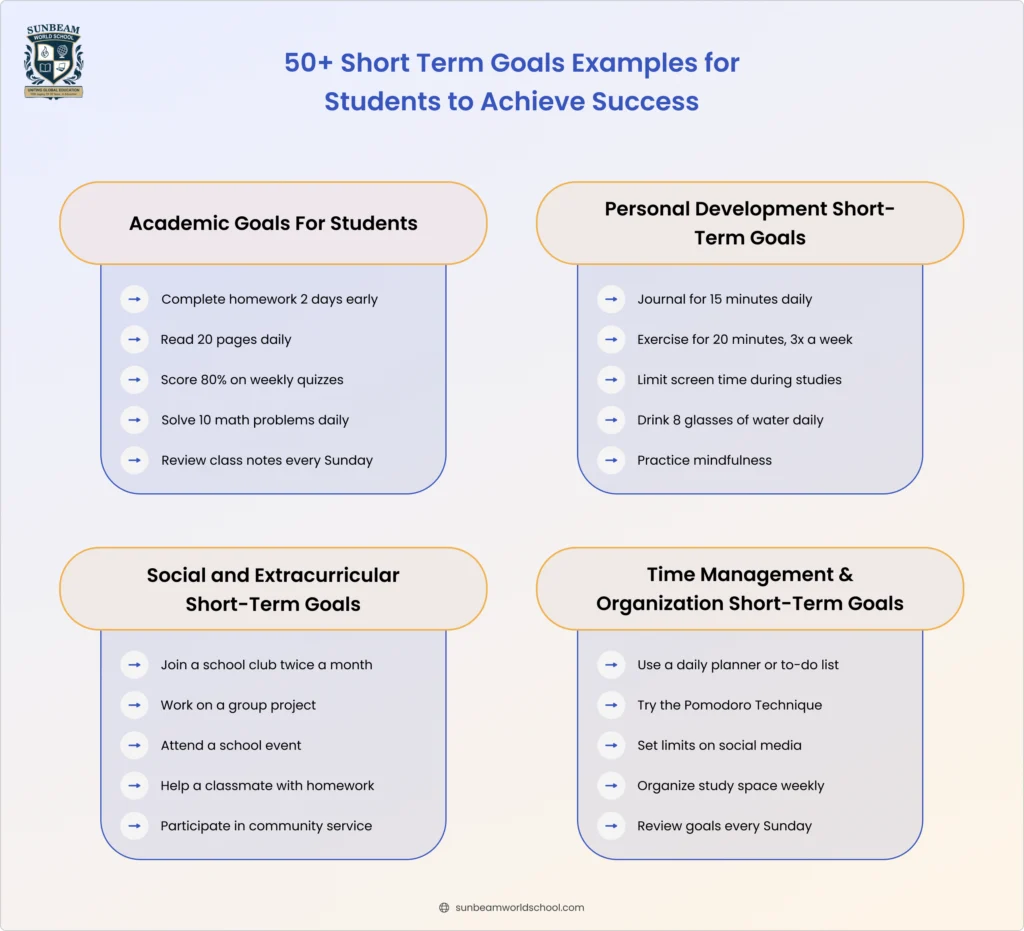
Setting short-term goals for students is crucial for building habits, improving performance, and achieving both academic and personal milestones. These goals are actionable, measurable, and achievable within days, weeks, or months.
Dividing goals into categories helps students, parents, and teachers focus on specific areas of growth.
1. Academic Goals For Students
Academic goals focus on improving grades, understanding subjects, and building effective study habits.
Examples:
- Complete all homework assignments two days before the deadline each week.
- Read 20 pages of a textbook or storybook daily for one month.
- Review and summarize class notes every Sunday evening.
- Solve at least 10 practice problems in math or science daily.
- Memorize 10 new vocabulary words each day for one week.
- Score at least 80% in weekly quizzes.
- Participate in at least one class discussion per week.
- Submit all essays with at least one revision after peer feedback.
- Dedicate 30 minutes daily to study a weaker subject for a month.
- Watch one educational video or tutorial per day on a specific topic.
- Complete all reading assignments a day before class.
- Create a weekly study timetable and stick to it for four weeks.
- Practice past exam papers at least twice a week.
- Take notes during online or in-person lectures and review them the same day.
- Organize digital and physical study materials weekly for better efficiency.
2. Personal Development Short-Term Goals
These goals help students develop life skills, self-discipline, and personal growth habits.
Examples:
- Spend 15 minutes daily journaling thoughts or reflections for two weeks.
- Practice mindfulness or meditation for 10 minutes every day.
- Limit screen time to 30 minutes during study periods.
- Wake up and sleep at consistent times for a week.
- Drink at least 8 glasses of water daily for one week.
- Exercise for at least 20 minutes, three times per week.
- Take up a hobby (music, art, coding) for at least 90 minutes weekly.
- Read one personal development or motivational article weekly.
- Write down three achievements at the end of each day for one week.
- Set a daily digital-free time of 1–2 hours for focused work.
- Reduce caffeine or sugary drinks after 4:00 PM for two weeks.
- Practice deep breathing exercises before exams or stressful tasks.
- Keep a gratitude journal by writing one positive thing each day.
- Spend 10 minutes reflecting on strengths and areas for improvement daily.
- Volunteer for a school or community activity at least once per month.
3. Social and Extracurricular Short-Term Goals
These goals focus on teamwork, social skills, and extracurricular engagement.
Examples:
- Join and actively participate in a school club twice a month.
- Collaborate with classmates on one group project per month.
- Attend one school event or seminar every two weeks.
- Practice a team sport for at least 45 minutes twice a week.
- Organize a small study group once a week for peer learning.
- Present one idea or solution during group discussions weekly.
- Participate in a creative contest or competition monthly.
- Connect with a new classmate or peer each week to build social skills.
- Share learned knowledge with friends or siblings once a week.
- Help a classmate with homework or a project once per week.
- Attend online workshops or webinars relevant to hobbies or academics.
- Practice public speaking in front of a mirror or a small audience weekly.
- Write one letter or note to a friend, teacher, or mentor each month.
- Take part in community service activities twice a month.
- Create a collaborative mini-project with peers for a class presentation.
4. Time Management & Organization Short-Term Goals
Effective time management ensures students balance academics, personal growth, and extracurriculars efficiently.
Examples:
- Plan each day in advance for one week using a to-do list or planner.
- Use the Pomodoro technique (50 minutes study, 10 minutes break) for daily study sessions.
- Allocate one hour weekly for reviewing past mistakes and learning from them.
- Track weekly study hours and aim to improve by 10% the next week.
- Organize study space, stationery, and digital files every weekend.
- Complete at least one task from the to-do list before leisure activities daily.
- Set specific time limits for social media use daily.
- Divide long-term projects into small weekly milestones.
- Allocate a daily 15-minute reflection period to assess productivity.
- Review and adjust the weekly timetable every Sunday evening.
- Prioritize assignments by urgency and importance for one month.
- Avoid multitasking during study hours for better focus.
- Track and celebrate small accomplishments weekly.
- Batch similar tasks together (e.g., assignments, reading, research) to save time.
How to Track Your Goals for School Children
While Setting goals is only half the journey – tracking them ensures students stay on course, remain motivated, and can celebrate small wins along the way.
For parents and teachers, tracking provides insight into progress, highlights challenges early, and allows timely interventions. Here’s how to do it effectively:
1. Use a Goal Journal or Planner
Encourage children to maintain a dedicated notebook or digital planner for all their goals. They can write down daily, weekly, or monthly targets, along with notes on progress. This not only creates accountability but also helps them visualize their achievements.
2. Break Goals into Smaller Steps
Long-term objectives can feel overwhelming. Divide each goal into small, actionable tasks. For example, if the goal is “improve math grades,” smaller steps could include completing five practice problems daily or revising one topic per day. Tracking these micro-tasks makes progress measurable.
3. Set Deadlines and Milestones
Assign time frames for each task or goal. Short deadlines create a sense of urgency and help children prioritize their activities. Celebrate milestones to keep motivation high, whether it’s finishing a project or improving a quiz score.
4. Use Visual Tracking Tools
Charts, stickers, progress bars, or apps can make goal tracking fun and interactive. Visual representation motivates children as they see their progress at a glance, making goal achievement tangible and rewarding.
5. Regular Reviews and Reflection
Schedule weekly or monthly review sessions with your child. Discuss what went well, what needs improvement, and how to adjust strategies. This reflection builds critical thinking, self-awareness, and ownership of learning.
6. Encourage Accountability and Support
Parents and teachers should provide guidance and positive reinforcement. Asking questions like “What’s your goal this week?” or “How did you progress today?” encourages accountability and shows children that their efforts are valued.
7. Adjust Goals When Necessary
Sometimes, goals need flexibility. If a child struggles with a task, modify the goal or provide additional resources. Tracking is not about rigid rules — it’s about continuous learning and growth.
Mistakes Students Make When Goal-Setting
Setting goals is a powerful way for students to improve focus and academic performance, but common mistakes can reduce their effectiveness. Understanding these pitfalls helps students set goals that are realistic, actionable, and motivating.
-Setting Vague Goals
Goals like “do better in school” are too broad. Without clear, measurable targets, it’s hard to track progress or stay motivated.
-Ignoring Timeframes
Short-term goals need a specific deadline. Goals without a timeline often get delayed or forgotten.
-Setting Unrealistic Goals
Goals that are too difficult or ambitious can lead to frustration and discouragement. Start small and gradually increase difficulty.
-Not Tracking Progress
Students may set goals but fail to monitor their progress. Regular tracking helps celebrate achievements and adjust plans if needed.
-Lack of Focus on One Goal at a Time
Trying to achieve too many goals simultaneously can split attention and reduce effectiveness. Prioritize and focus on a few short-term goals.
-Ignoring Motivation and Rewards
Without motivation or a reward system, students may lose interest. Celebrate small wins to maintain enthusiasm.
Bonus Tips: 10 Healthy Habits for Student Success-Maintain a consistent sleep schedule. -Eat a balanced and nutritious diet. -Exercise regularly to stay active. -Practice effective time management. -Follow a structured study routine. -Manage stress with mindfulness or meditation. -Limit unnecessary screen time. -Stay hydrated throughout the day. -Set and track short-term goals. -Build positive social connections. |
The Bottom Line
As the saying goes, “Small wins pave the way for big victories.” Breaking larger tasks into smaller, achievable short-term goals helps students track progress, build confidence, and develop essential skills.
Research also shows that setting and achieving short-term goals for students boosts motivation, enhances learning outcomes, and fosters perseverance (Krumrei-Mancuso, Newton, Kim, & Wilcox, 2013).
At SunBeam World School, we guide students in setting meaningful short-term goals through structured learning programs, personalized mentoring, and continuous progress tracking. Also, provide supportive environment to ensure that every student cultivates lifelong learning habits, a growth mindset, and the skills needed to excel in school and beyond.
Happy Learning!
FAQs
1. What is a short-term goal for a student?
A short-term goal for a student is a specific, achievable objective set for days, weeks, or months. It helps improve focus, track progress, build discipline, and achieve academic, personal, or extracurricular milestones effectively.
2. What is a good goal for time management?
A good time management goal is clear, measurable, and achievable, like completing daily assignments on schedule, allocating study hours effectively, or using a planner to balance academics, extracurriculars, and personal activities efficiently.
3. What is your short-term goal’s best answer for students?
A strong short-term goal answer for students focuses on actionable, measurable tasks, such as completing homework on time, reading a chapter daily, or practicing a subject skill consistently to improve performance in the near term.
4. What does SMART goals mean for students in school?
In school, SMART goals for students are Specific, Measurable, Achievable, Relevant, and Time-bound objectives. They help students set clear, realistic targets, track progress, stay motivated, and achieve academic and personal growth efficiently.
5. What is an example of a short term goal?
An example of a short-term goal is completing five math practice problems daily for a week or reading 20 pages of a textbook each day to improve understanding and maintain consistent study habits.
6. Which goal is best for students?
The best goal for students is specific, measurable, achievable, relevant, and time-bound (SMART). It aligns with academic or personal growth, motivates consistent effort, and builds skills, discipline, and confidence over time.
In this article



Share this post:


Press and Blogs
Stay updated with our press releases, educational blogs, and more.

What to do after Class 10 is what many students and parents wonder about. The...

One can study effectively using research-backed study tips and smart techniques rather than long, passive...

In today’s rapidly evolving, technology-driven world, STEM and STEAM education must go beyond textbooks to...