

 Academic Excellence
How to Handle Failure in Exams – 10 Practical Strategies for Students
Failing an exam doesn’t define a student’s potential. Use these practical strategies to bounce back quickly:
Result: Faster recovery, reduced stress, and better performance in future exams. |
Dealing with exam failure can be challenging, whether you are a student facing disappointment, a parent worried about your child, or a teacher guiding learners through tough results. Exam failure can trigger stress, anxiety, and self-doubt, affecting both confidence and mental health.
In this blog, we will help you with effective strategies and practical tips for coping with exam failure to support students in bouncing back, building resilience, and turning setbacks into opportunities for growth and improved performance.
Why Exam Failure Feels So Difficult
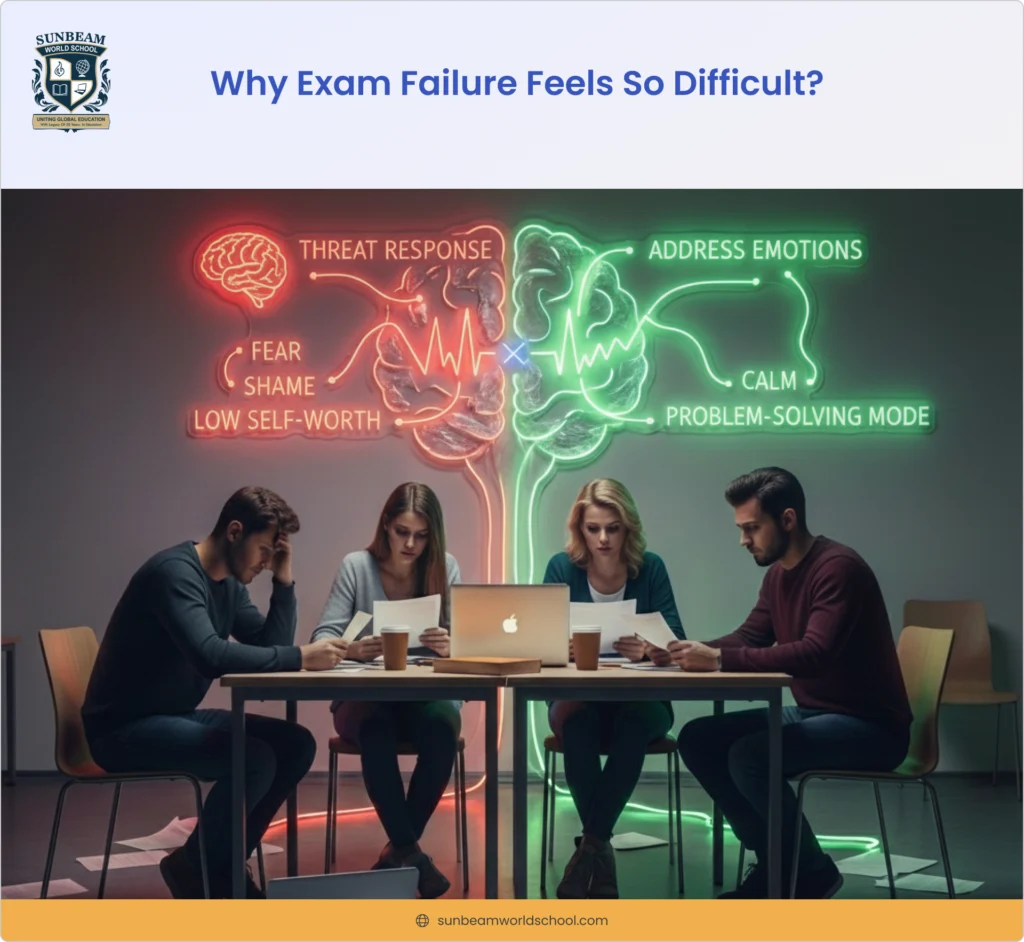
Exam failure feels deeply painful because it triggers psychological responses linked to fear, identity, and self-worth. From an early age, students are conditioned to associate academic success with approval from parents, teachers, and society. When expectations are high, failure activates the brain’s threat response, making students feel stressed, ashamed, or unsafe—even though no real danger exists.
The fear of judgment intensifies these emotions. Students often compare themselves to peers, which psychologists call social comparison, leading to self-doubt and negative self-talk. Over time, repeated comparison can damage confidence and motivation, making failure feel permanent rather than temporary.
According to educational psychology, ignoring these emotions delays recovery. Addressing feelings first helps calm the nervous system, improves emotional regulation, and allows the brain to shift from fear mode to problem-solving mode – making meaningful improvement possible.
Why Students Fail in Exams
Most students fail due to a combination of academic gaps, ineffective study strategies, emotional pressure, and exam-related stress. Understanding the real reasons behind exam failure helps students, parents, and educators address the root causes—turning setbacks into opportunities for growth and improvement.
1. Fear, Anxiety & Exam Pressure
Exams activate the brain’s stress response. When anxiety rises, the brain’s working memory struggles to retrieve information. Fear of disappointing parents, teachers, or failing board exams often leads to blank answers, panic, and mistakes—even when the student is well prepared.
2. Lack of Conceptual Clarity
Many students memorize answers without understanding the underlying concepts. While this may help in small tests, board exams now focus on application-based and competency questions. Without strong conceptual foundations, students struggle to analyze, apply, or explain answers accurately.
3. Poor Study Strategy
Studying without a clear plan leads to inefficiency. Common issues include skipping weak subjects, excessive reading without practice, and lack of revision. Passive studying fails to create long-term memory. Without active recall, practice questions, and regular revision, knowledge fades quickly before exams.
4. Ineffective Time Management
Some students study irregularly or start preparation too late. Others know the syllabus but fail to manage time during the exam. Spending too long on one question leaves others unanswered, resulting in unnecessary loss of marks despite adequate subject knowledge.
5. Overdependence on Tuition or Coaching
Coaching can guide learning, but exams test independent thinking. Many students rely entirely on tuition notes and do not revise or practice on their own. Without self-study, concept reinforcement and confidence remain weak, affecting exam performance.
6. Lack of Practice With Exam Patterns
Students who avoid solving sample papers and previous-year questions often feel unprepared in the exam hall. Unfamiliar question formats, case-based problems, and time pressure cause confusion. Regular mock tests help build confidence and improve speed and accuracy.
7. Emotional or Personal Issues
Stress at home, peer pressure, health problems, or low self-esteem can distract students from studies. Emotional distress reduces concentration and motivation. When mental well-being is ignored, learning becomes difficult, no matter how good the study material or teaching is.
8. Comparison & Low Self-Confidence
Constant comparison with classmates, siblings, or toppers damages self-belief. Over time, students begin to doubt their abilities. This negative mindset creates a self-fulfilling cycle where fear of failure leads to poor performance, reinforcing the belief that they cannot succeed.
9. Weak Foundation From Previous Classes
Unclear basics in Maths, Science, or language subjects create difficulties in higher classes. When foundational concepts are missing, new topics feel overwhelming. Students spend more time memorizing instead of understanding, leading to repeated confusion and exam failure.
10. Poor Exam Presentation
Some students know answers but lose marks due to poor handwriting, lack of stepwise solutions, or missing keywords. Ignoring diagrams, headings, or CBSE marking schemes reduces scores. Clear presentation helps examiners award full marks for correct understanding.
10 Effective Ways – How To Recover From Exam Failure
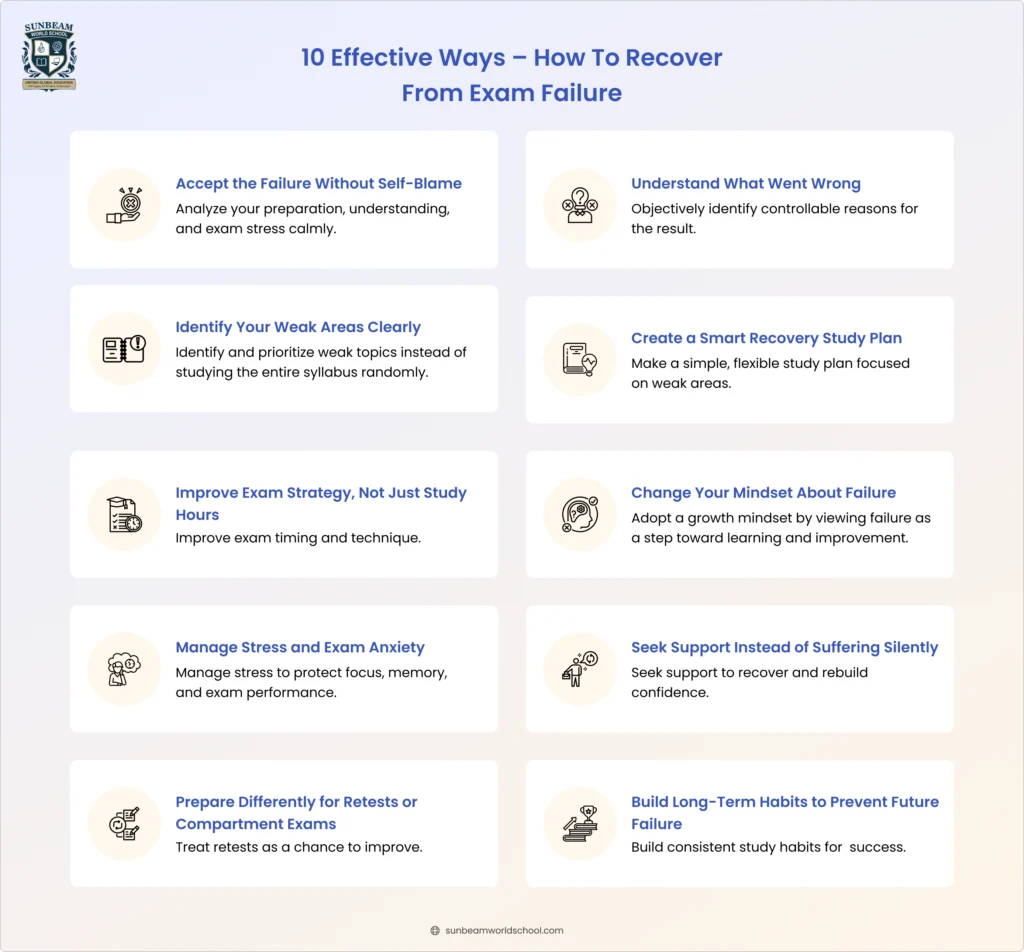
Exam failure is a common experience among students and does not reflect a lack of potential. These ten effective strategies on what to do after exam failure will help students bounce back stronger and more prepared.
1. Accept the Failure Without Self-Blame
The first and most important step after exam failure is acceptance—not denial, not excuses, and definitely not self-criticism. Many students immediately label themselves as “weak” or “not good enough,” but psychology shows that excessive self-blame activates stress responses and reduces problem-solving ability.
Accepting failure does not mean giving up. It means acknowledging the result as feedback rather than a personal flaw. Allow yourself to feel disappointed, frustrated, or upset—these emotions are natural. However, avoid harsh self-talk like “I always fail” or “I’m useless.”
When you stop attacking yourself, your mind becomes calmer and more open to improvement. Acceptance creates emotional stability, which is essential before planning your next steps.
2. Understand What Went Wrong
Once emotions settle, it’s time to reflect objectively. This step is about understanding the reasons behind the result—not replaying mistakes endlessly.
Ask yourself simple, honest questions:
-Did I understand the syllabus clearly?
-Was my preparation consistent or last-minute?
-Did exam stress affect my performance?
-Did I practice enough sample papers?
Break the reasons into academic factors (weak concepts, poor revision, lack of practice) and non-academic factors (stress, sleep deprivation, poor time management). This method, used in educational psychology, prevents emotional bias and helps students focus on controllable factors.
3. Identify Your Weak Areas Clearly
Many students fail again because they study everything randomly instead of fixing specific weaknesses. To move forward, you must pinpoint exactly where you struggled.
Divide your syllabus into three categories:
-Topics you know well
-Topics you partially understand
-Topics you find difficult or confusing
This clarity allows you to prioritize effectively. Focusing on weak areas first gives faster improvement and builds confidence early. Research shows that targeted learning improves retention far more than repeated full-syllabus revision. Clear identification transforms failure into a clear action plan.
4. Create a Smart Recovery Study Plan
After identifying gaps, the next step is building a realistic and flexible study plan. Avoid overloading yourself—extreme schedules often lead to burnout and demotivation.
Your recovery plan should include:
-Daily concept revision
-Regular practice questions
-Weekly mock tests
-Short revision breaks
Allocate more time to high-weightage and weak topics, but continue revising strong areas to maintain confidence. Use short study blocks (40–50 minutes) with breaks to improve focus.
A well-planned schedule gives students a sense of control, which psychologists say reduces anxiety and increases motivation.
5. Improve Exam Strategy, Not Just Study Hours
Studying more hours does not always mean better results. Many students fail due to poor exam strategy, not lack of knowledge.
Work on:
-Time management during exams
-Answer presentation (headings, points, diagrams)
-Reading questions carefully
-Attempting easy questions first
Practice under exam-like conditions to reduce anxiety and improve speed. Mock tests train your brain to perform under pressure, which boosts confidence and accuracy.
6. Change Your Mindset About Failure
One of the biggest differences between students who improve and those who don’t is mindset. A fixed mindset believes failure means lack of ability. A growth mindset sees failure as a learning opportunity.
Replace thoughts like:
“I’m bad at studies”
with
“I haven’t mastered this yet”
This shift may seem small, but it rewires how the brain responds to challenges. Students with a growth mindset recover faster, stay motivated, and perform better in future exams.
7. Manage Stress and Exam Anxiety
Failure often increases fear of future exams. If not managed, anxiety can block memory, concentration, and performance.
Simple techniques to manage stress:
-Deep breathing before study sessions
-Short physical activity or stretching
-Proper sleep and hydration
-Taking breaks without guilt
According to psychology, calming the nervous system helps the brain shift from survival mode to learning mode. Managing stress is not optional—it’s essential for improvement.
8. Seek Support Instead of Suffering Silently
You don’t have to deal with exam failure alone. Talking to teachers, parents, or mentors provides emotional relief and practical guidance.
Teachers can:
-Explain weak concepts
-Suggest better strategies
-Provide reassurance
Parents and mentors can help reduce pressure and rebuild confidence. Seeking support is a strength, not a weakness. Students who communicate openly recover faster and feel less isolated.
9. Prepare Differently for Retests or Compartment Exams
If you have a retest or compartment exam, treat it as a second opportunity, not a punishment.
Focus on:
-Mistake-based revision
-Practice questions from weak areas
-Regular mock tests
-Confidence rebuilding
Start early and revise smartly. Many students clear compartment exams with better scores simply because they now understand the exam pattern and expectations.
10. Build Long-Term Habits to Prevent Future Failure
Long-term success comes from consistent habits, not last-minute effort.
Develop habits like:
-Daily revision
-Weekly self-tests
-Organized notes
-Balanced routine (study + rest)
These habits improve retention, reduce stress, and make exams feel manageable rather than overwhelming. Over time, they transform failure into sustained academic growth.
Student Exam Stress Tips That Actually Work
Studying harder doesn’t always lead to better results—studying smarter does. Research in cognitive psychology shows that effective learning depends on how the brain processes, stores, and retrieves information. Dealing with exam failure tips will help you improve memory, and exam performance.
1. Active Recall Instead of Passive Reading
Simply rereading notes creates familiarity, not mastery. Active recall—testing yourself without looking at notes—forces the brain to retrieve information, strengthening memory and understanding.
2. Spaced Revision for Long-Term Memory
Cramming leads to quick forgetting. Spaced repetition, where topics are revised over days or weeks, helps transfer information from short-term to long-term memory.
3. Practice With Exam-Style Questions
Solving previous years’ papers and mock tests improves speed, accuracy, and confidence. It also trains the brain to handle exam pressure effectively.
4. Teach What You Learn
Explaining concepts out loud—as if teaching someone else—reveals gaps in understanding and reinforces clarity.
5. Focused Study Sessions With Breaks
Short, distraction-free study sessions (40–50 minutes) followed by breaks improve concentration and reduce burnout.
These techniques turn effort into results—and help students study with confidence, not stress.
Smart & Realistic CBSE-Focused Study Plan
A CBSE study plan should focus on concept clarity, regular revision, and exam-oriented practice rather than long study hours. Since CBSE emphasizes application-based questions, students must prepare strategically. This structured approach reduces stress, improves retention, and aligns perfectly with CBSE evaluation patterns.
Daily Study Structure
Divide your day into 3 focused study blocks of 40–50 minutes each.
-Block 1: Learn or revise new concepts
-Block 2: Practice NCERT questions and examples
-Block 3: Active recall and short revision
Weekly Strategy
-Revise weak topics at the start of the week
-Solve CBSE sample papers or previous-year questions on weekends
-Analyze mistakes and update notes
Monthly Preparation
-Complete one full syllabus revision every month
-Attempt at least 2 full-length mock tests
-Focus on presentation, time management, and accuracy
Subject-Wise Focus
-Theory subjects: Concept clarity + answer writing practice
-Numerical subjects: Daily problem-solving + formula revision
Sample Recovery Plan to Handle Failure in Exams
Failing an exam can feel like everything has stopped—but in reality, it’s the starting point of improvement. A clear recovery plan helps students regain confidence, rebuild study habits, and move forward with purpose instead of panic.
Week 1: Emotional Reset & Honest Reflection
Before focusing on books, address emotions.
-Accept the result without self-blame
-Talk openly with a parent, teacher, or mentor
-Write down what went wrong (concepts, time management, stress)
-Take 2–3 days to mentally reset
Psychology tip: Emotional clarity improves focus and memory retention.
Week 2: Diagnose Weak Areas
Now shift to academics.
-Analyze answer sheets (if available)
-Identify weak chapters and question types
-Understand whether the issue was conceptual, practice-based, or exam anxiety
Create a realistic improvement list—not a punishment schedule.
Week 3–4: Rebuild With Smart Study
-Study NCERT line-by-line
-Practice topic-wise questions daily
-Use active recall and spaced revision
-Focus on one weak subject at a time
Short, consistent sessions work better than long, forced study hours.
Week 5: Exam Simulation & Confidence Building
-Attempt sample papers under exam conditions
-Practice time management
-Improve answer presentation (headings, steps, diagrams)
-Review mistakes calmly
Each mock test is training—not judgment.
Ongoing: Mindset & Routine Maintenance
-Sleep 7–8 hours
-Avoid constant comparison
-Celebrate small improvements
-Replace “I failed” with “I’m improving”
Consistency beats perfection.
How Parents Should Support Their Child After Exam Failure
When a child fails an exam, the pain is shared by the whole family. Parents often want to motivate—but the wrong words can increase fear instead of confidence. Below are the right approaches for managing exam failure emotions, explained with real-life examples.
1. Respond With Calm, Not Criticism
What parents often say (unhelpful):
“We spent so much money on coaching. What went wrong?”
What helps instead:
“I know this hurts. One exam does not define you. Let’s figure out the next step together.”
Why this works:
A calm response reduces stress hormones and helps the child think clearly.
2. Let Your Child Express Their Emotions
Example:
Your child says, “I feel ashamed.”
Instead of correcting them, say:
“It’s okay to feel that way. I’m listening.”
Avoid rushing into advice. Emotional release is the first step to recovery.
3. Separate Marks From Self-Worth
Wrong message:
“If you had studied harder, this wouldn’t happen.”
Right message:
“Marks show performance, not intelligence. Many successful people failed exams before succeeding.”
Example:
Remind them that improvement matters more than perfection.
4. Avoid Comparisons Completely
Common mistake:
“Your cousin scored 90%. Why can’t you?”
Better approach:
“You’ve improved in Maths compared to last term. Let’s build on that.”
Comparisons damage confidence and create long-term fear of failure.
5. Analyze the Failure Without Blame
Example conversation:
“Did you find the paper difficult, or was time management the issue?”
Work together to identify:
-Weak concepts
-Exam pressure
-Lack of practice
The focus should be on solutions, not punishment.
6. Create a Supportive Study Routine
Example:
Instead of saying “Study all day”, say:
“Let’s study for 45 minutes and take a short break.”
Parents can help by:
-Fixing a routine
-Limiting distractions
-Ensuring rest and nutrition
Small structure builds consistency.
7. Praise Effort, Not Just Results
Example:
Your child studied regularly but still failed.
Say: “I noticed how consistently you studied. That effort matters and will show results.”
This encourages persistence and a growth mindset.
8. Watch for Emotional Warning Signs
Example: If your child:
-Stops talking
-Avoids books completely
-Says “I’m useless”
Don’t ignore it. Talk to a teacher or counselor early.
9. Work With Teachers as Partners
Example:
Ask the teacher:
“Which areas should my child focus on to improve?”
This shows the child that support systems exist, reducing fear.
BONUS BOX:
Mindset Boost After Exam FailureFailing an exam is not the end—it’s a stepping stone to growth. Remember:
Key takeaway: Your potential is bigger than a single result. Bounce back with confidence and keep moving forward. |
The Bottom Line
Dealing with exam failure is never easy, but it can become a turning point rather than a roadblock. When students learn to cope with exam failure with patience, support, and smart strategies, they develop resilience that helps them succeed beyond academics.
“Failure is simply the opportunity to begin again, this time more intelligently.”
Thus, with consistent effort, emotional support from parents and teachers, and practical planning, improvement is always possible. At Sunbeam World School, we believe every child has the potential to grow, learn, and succeed—even after setbacks—when guided with care, confidence, and the right educational support.
FAQs
1. Is failing in an exam a failure in life?-
No, failing an exam is not a failure in life. It is a temporary academic setback, not a measure of intelligence or future success. Many successful people faced exam failures but improved through learning, resilience, and better strategies.
2. How can parents and teachers help students with exam failures?
Parents and teachers can help by offering emotional support, avoiding blame, identifying learning gaps, and encouraging positive study habits. Creating a safe environment helps students rebuild confidence and focus on improvement instead of fear.
3. How to bounce back from failing an exam?
To bounce back after exam failure, students should accept the result, analyze mistakes, improve study methods, practice regularly, and manage stress. Consistent effort, proper guidance, and a positive mindset help students recover and perform better.
4. What happens if you fail a test?
Failing a test may lower confidence temporarily, but it does not end academic progress. Students can reattempt exams, improve weak areas, and learn better strategies. Failure highlights gaps that can be fixed with proper guidance.
5. How to deal with failure in exams?
Dealing with exam failure involves acknowledging emotions, avoiding self-blame, seeking support, and focusing on solutions. Students should use failure as feedback to improve preparation, time management, and exam techniques.
6. Why do students fail in exams despite studying hard?
Students may fail despite studying hard due to exam anxiety, poor revision, weak concepts, ineffective study methods, or lack of practice with exam patterns. Smart study techniques and emotional balance are as important as effort.
7. Is Class 10 exam failure very serious for a student’s future?
No, failing Class 10 is not the end of a student’s future. With compartment exams, re-evaluation options, and alternative academic paths, students can recover and continue their education successfully.
8. Can students still succeed after failing Class 12 exams?
Yes, many students succeed after failing Class 12. They can reappear for exams, improve preparation, or explore alternative education options. Exam failure does not limit long-term career or life opportunities.
9. How should parents support Class 10 and 12 students after failure?
Parents should stay calm, avoid comparisons, listen to their child, and focus on improvement plans. Emotional support and reassurance help students regain confidence and perform better in future exams.
10. How can Class 10 and 12 students bounce back after exam failure?
Students should accept the result, identify weak areas, follow a structured CBSE study plan, practice sample papers, and manage stress. Consistent effort and guidance help students recover and improve results.
11. What are the passing marks out of 80 in Class 10 CBSE?
For an 80-mark theory paper, 33% equals 26.4 marks, which CBSE rounds to 27 marks. Scoring 27 or more in theory helps meet the passing criteria.
In this article



Share this post:


Press and Blogs
Stay updated with our press releases, educational blogs, and more.

Bullying in schools is a widespread issue that adversely affects student well‑being, academic success, and...

In today’s rapidly evolving, technology-driven world, STEM and STEAM education must go beyond textbooks to...

In Georgia, parents are increasingly exploring online learning, distance learning or simply online education as...
